
Women in the workforce: Changing representations of the female demographic

Once upon a time, there was a women.
She was taught how to cook, clean and look after children. When she grew up, she got married and cooked, cleaned and looked after her children. The End.
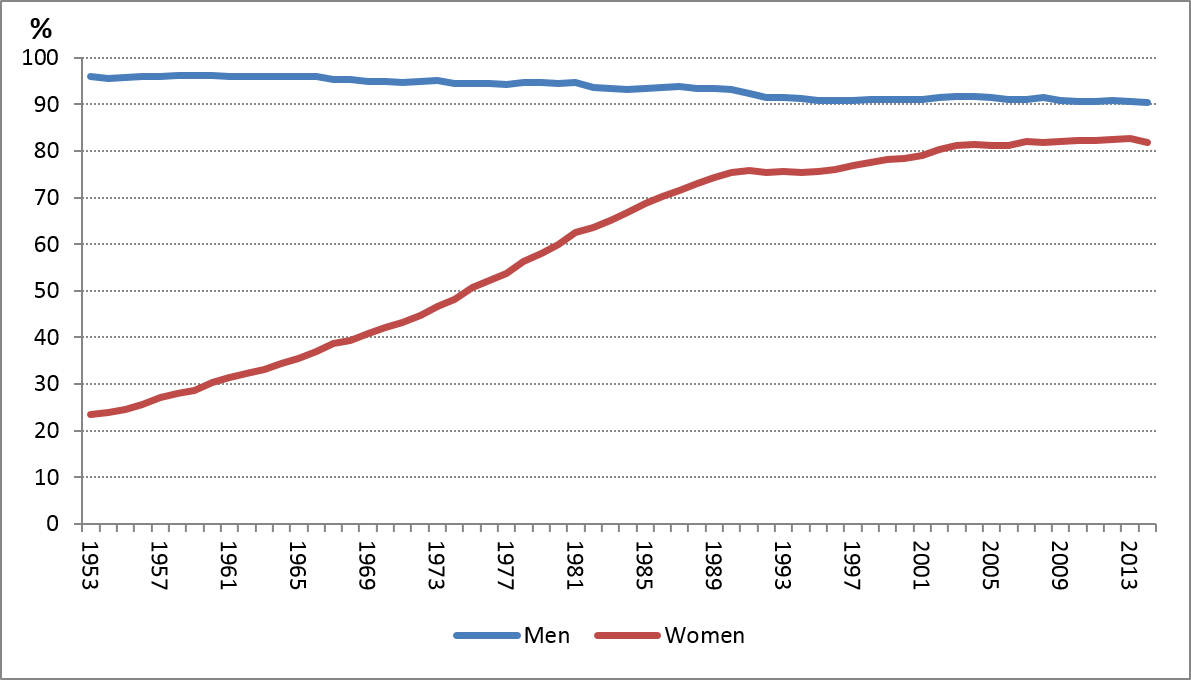
Image result for working population of women over time
Fig 1 (Source: Statistics Canada)
That is essentially a summary of what society thought (for a good chunk of recorded history) was the sole purpose of women, to take care of the house, and to raise the kids. However, in recent years, there has been an increasing number of women becoming the primary bread-winners of their family and an even larger number of women entering the workforce (Fig 1). Such a big shift in society may be associated with the rise of many feminists (not just women, men too) and simply a lot of women are standing up for themselves, saying that the society's beliefs shouldn't decide the outcome of their lives: they should. However, despite such shifts, in even Australia there is still supposedly a wage gap between women and men of 15.3% (ABS). Though this is probably not completely caused by discrimination in the workforce, it still doesn't make sense why it hasn't been almost nullified as women may have certain benefits over men in areas such as organisation, quite a useful asset for the majority of businesses and corporations. Another reason for such a trend is likely that most women are more attracted to lower-paying jobs, mainly part-time jobs.

Looking at the problem from a different point of view: evolution points at women as the ones to give birth to the child and bring them up, a trend common in many species of the animal kingdom. They were specifically designed by nature over millennia to the most efficient child-bearer. However, humans have come a long way from the times of old and now rather than relying on nature for survival we have become a much more self sustaining species and have figured out how to do many things even the forces of nature can't do.

In this course, it will be interesting to find out how shifts in humanity have and will affect the society's representation of the female demographic.

Comments

Popular posts from this blog

Best Actress 1976 + 1991 Academy Awards

A character analysis and comparison of the roles demonstrated in  the Best Actress category at the 1976 and 1991 Academy Awards  Background The two films under the spotlight are One Flew Over the Cuckoo's Nest (1975) and Misery (1990). Both films are film adaptations of the novels of the same titles. I decided to analyse the Best Actress Academy Award as this is in my opinion what Hollywood decides as the peak of female representation of that year and such deserves to be rewarded for its achievements. I chose too analyse these two films as they both feature a Woman as a Nurse and as the main antagonist of the films. 15 years was also a nice time gap that would create a more interesting and apparent difference in representation instead of a smaller time gap of only a few years. One Flew Over the Cuckoo's Nest (1975) Background information about the film One Flew Over the Cuckoo's Nest (1975) is a film adaptation of the 1962 novel of the same title by Ken Kesey. ...

Girl With A Pearl Earring

Girl With A Pearl Earring Johanne Vermeers' Girl with a Pearl Earring Painting In the novel "Girl with a Pearl Earring" the story rotates around the character "Griet" and her life as a maid for the painter Johannes Vermeers' family, and all the ups and downs of her life working for them, including when Vermeer paints her for his, now world famous, painting "Girl with a Pearl Earring." Griet comes from a protestant family with three children (Griet (15/16), her younger brother Frans (~14-15) and her younger sister Agnes (~12)) living in the dutch town of Deflt which is shown as a relatively small town. Griets' family falls to poverty after her father is blinded in an accident with a kiln explosion, taking his craft of tile-painting when he is blinded. This means Griet has to go and work for the Vermeers' where the painter needs a maid who can clean without moving anything and Griets parents volunteer her. There are a lot of small...
Women Over Time Even before this unit, the representation of women had been a topic I was interested in. With social media nowadays, the subject comes up even more often, and has sparked many debates and protests. However, when the unit began, I realised that the sexism experienced by women was still a major ongoing problem in our society. Women are often portrayed as inferior to men. They are objectified, and pressurised to be physically beautiful, because society has forced them into believing that that is their role. Society has guided them from a young age, through books and movies and toys, to care more about their appearance than their aspirations and goals. Men, on the other hand, had whatever they needed to achieve their dreams from a young age. Wanted to become a police officer? Buy a toy gun. Wanted to be an explorer? Grab a pair of binoculars. And if a girl wanted to become any of those things, buying anything from the boys' section was frowned upon by society. Unle...